
Targeted Network Optimization for Foothill Regional Medical Center
Overview
When users at Foothill Regional Medical Center, a full-service acute care hospital in Tustin, California, reported intermittent connectivity on Workstations on Wheels (WOWs), the hospital needed to know whether it was looking at a coverage failure, a capacity problem, a configuration issue, or something outside the network entirely.
Techio was engaged to evaluate the existing environment, confirm what was actually installed, review the wireless controller configuration, and recommend improvements including any additional access points required.
Challenges
Unconfirmed Source of Connectivity Issues
Users were losing connectivity on WOWs, and the cause was not clear. In a hospital, that ambiguity is expensive in both directions. Acting on the wrong diagnosis means clinical staff keep losing connectivity on devices tied to EMR access and patient care workflows. Defaulting to more access points means spending on hardware that does not address the problem.
Unverified Access Point Records
IT had an access point map, but physical access point locations, hospital floor plans, and Cisco Meraki Dashboard records had never been reconciled. Nobody could say with confidence how many access points were live, or where. And without an accurate map, capacity can't be planned, issues take longer to isolate, and any hardware quote is built on inaccurate records.
Solution
Techio ran the project in two phases:
Phase 1: Diagnostic Assessment
Techio walked the building before recommending anything, verifying access point locations against the hospital's floor plans and Meraki Dashboard while measuring coverage, capacity, congestion, and internet throughput.
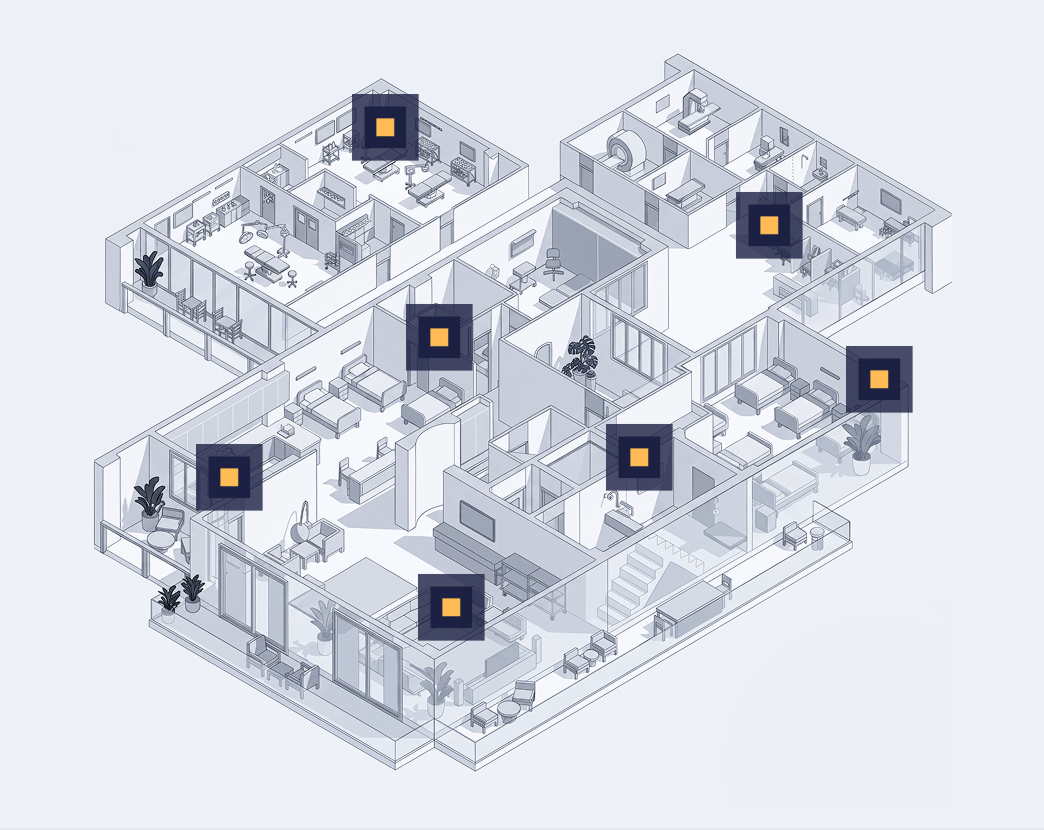
The first finding was that the map did not match the building: 24 active access points, several of them undocumented, and older equipment nobody could account for.Foothill’s unusual layout made inaccurate records harder to work around. Because the building is not a tower with repeating floors, there was no reliable pattern to infer from when the map was wrong.
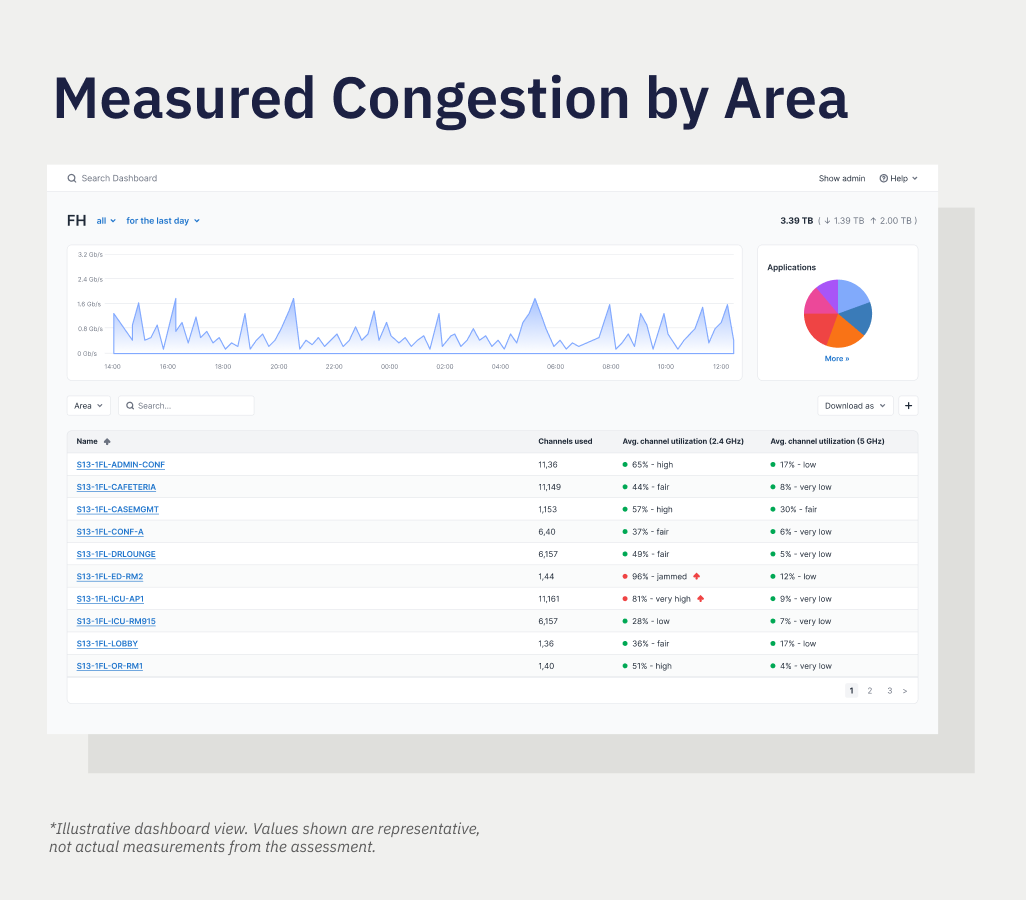
The performance findings were narrow. Congestion appeared in the main lobby and the ICU. Internet throughput at the firewall was inadequate for internal users and guests combined, which is a bandwidth constraint no amount of additional access points would fix. A handful of unmanaged devices were adding avoidable noise to the environment.
Techio then reproduced the WOWs issue rather than working from tickets and found no wireless problem at the access points serving the affected devices. The recommendation was to investigate the workstations themselves.
That finding is what prevented the expensive mistake. The assessment answered the original question and surfaced a separate set of issues. The WOWs problem was not wireless, but the same walkthrough found real coverage and capacity gaps that had to be addressed.
Phase 2: Implementation
Each part of the implementation traced directly back to a finding from the assessment.
Congestion in the lobby and ICU. The assessment identified these as the two areas of highest demand. Techio repositioned existing access points and added coverage in these locations to relieve the congestion the walkthrough measured.
Unverified access point records. The assessment found 24 active access points, several undocumented, against floor plans and Meraki records that had never been reconciled. Techio rebuilt the hospital's wireless documentation and updated the Meraki Dashboard to reflect verified access point locations, replacing records that could not previously be trusted for planning or troubleshooting.
Throughout the work, the existing Cisco Meraki infrastructure remained in place. No hardware was replaced. Techio monitored the environment following the changes, and a later expansion extended coverage into an additional area.
Outcomes
100% of existing Cisco Meraki infrastructure retained
$150K network overhaul avoided
20% expansion of the wireless network
100% of the wireless environment documented
Diagnosis Prevented Unnecessary Spend
Reproducing the WOWs connectivity issue showed that the cause was not the wireless network. That finding kept the hospital from spending on additional access points that would not have resolved it, and directed the issue to the correct team.
Expanded Capacity in High-Demand Areas
Congestion identified in the main lobby and the ICU was resolved through targeted access point changes in those specific locations, rather than a broad expansion across the building.
An Accurate Record of the Wireless Environment
The assessment reconciled floor plans, physical access points, and Meraki records that had never matched. All active access points were verified, replacing documentation IT could not previously rely on for planning or troubleshooting.
The Value: Performance Improvement Without a Full Network Replacement
Foothill avoided buying wireless infrastructure to solve a problem that was not wireless. The WOWs issue went to the team that could actually fix it, and spending went to the coverage, capacity, and throughput gaps the assessment confirmed.
The hospital extended the life of its existing Cisco Meraki environment, corrected records that had been unreliable for planning, and can now troubleshoot and expand against accurate records.